
It’s Starting to Feel Like a Real Game
Devlogs always take a bit of time to show up - usually because we’re too focused on production to actually sit down and write them ^^’ But here we are: welcome to the second devlog!
We wrapped up prototype v2 at the end of December, and after a short break, we jumped back into development with prototype v3.
This new version brings a lot of new things! We also invite you to check out our humble trailer video Youtube
Thorns and Slime
First of all, our main goal was to expand and improve exploration, which clearly lacked interest in the previous version.
We explored several directions for that. Our core idea was simple: we wanted the player to always have something to do.
In Lapinaut(the original jam game), players could continuously collect small rocks. But this solution didn’t feel sustainable in the long run for this project.
So we looked at more dynamic games, especially ones focused on “cleaning” mechanics, and started wondering: what if carving your way through a wild, overgrown “jungle” could be fun?
That’s how this new exploration layer was born.
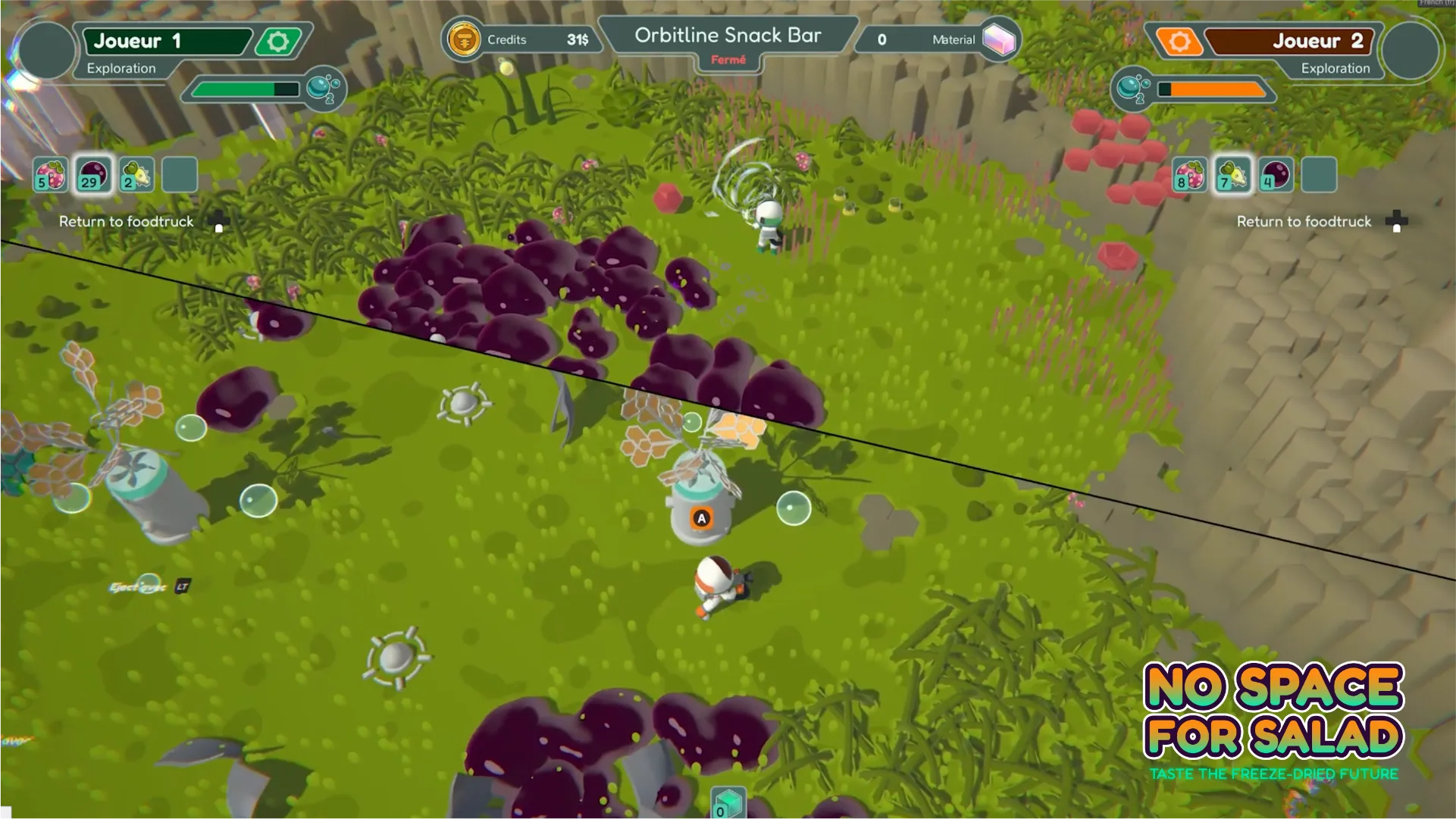
These elements aren’t just here to slow the player down or make exploration feel more demanding - these bushes also provide key resources for progression, giving real meaning to the act of “cleaning” them up.
- Thorns are dense bushes that the player can’t walk through. They’re fairly easy to vacuum and are full of Luma - small, juicy pink squashes. Did we mention that thorns grow back? Slowly, don’t worry.
- Slime is harder to remove, but the player can still walk through it… painfully. Slime is a type of fuel used by the franchise’s machines, and the player can collect it as well to build structures on planets.
Building on Planets
This has been the subject of many discussions on our side: building during exploration is a tricky topic.
As a small team, we couldn’t — and didn’t want to — aim for systems like fully craft- and build-focused games, where construction is the core experience. Here, it needed to stay secondary, but still interesting.
Even though this mechanic still needs improvements and expansion, it already added a lot of depth to exploration.
It’s also what pushed us to completely move away from fully procedural levels.
We are now working with hand-crafted levels, where the player keeps everything built or placed on a planet from one exploration session to the next. This felt like the most manageable decision within our current scope.
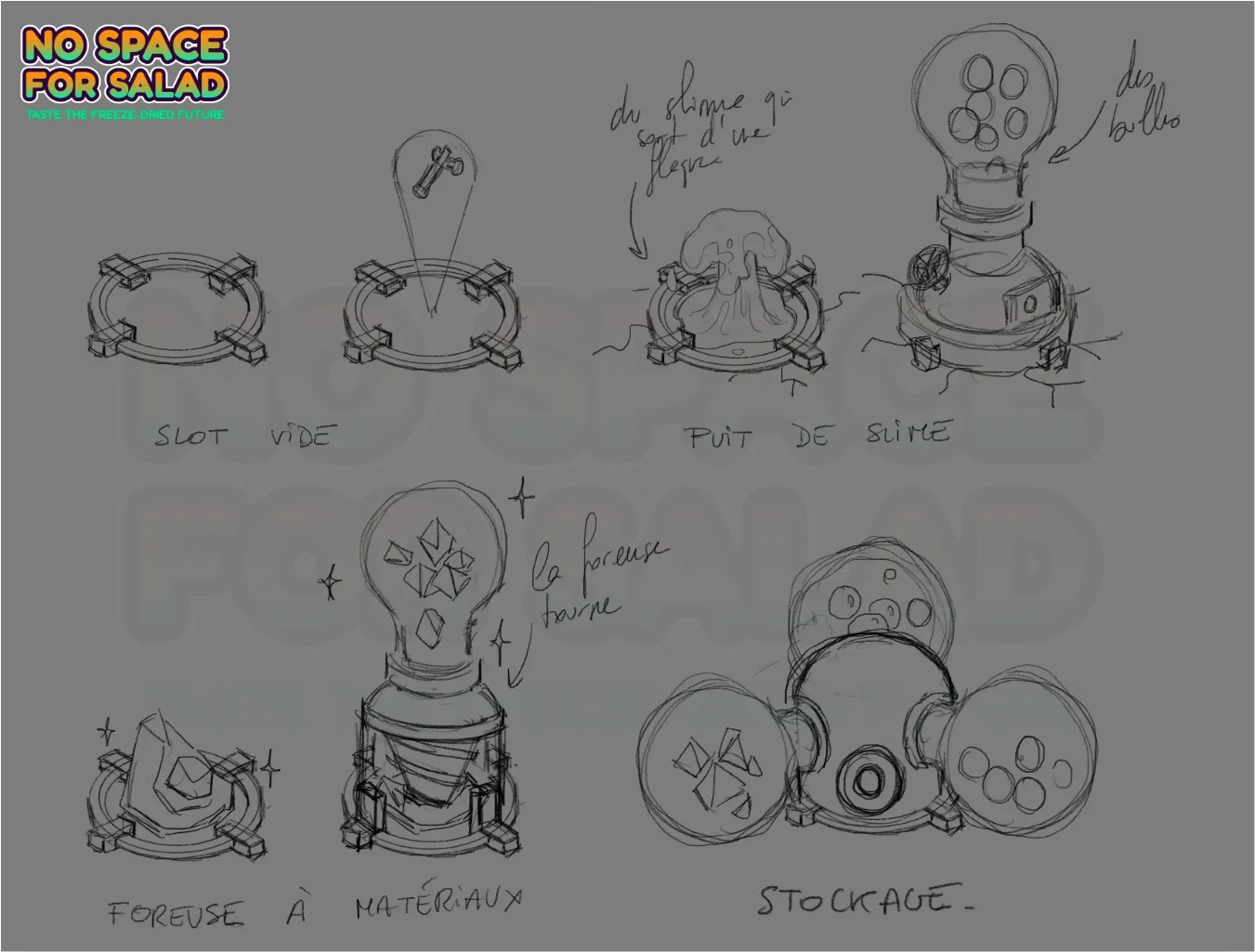
Building supports exploration, but also progression in the restaurant.
At the moment, players can build better oxygen distributors, material drills, slime wells, and storage — but much more is coming soon to expand these possibilities.
Ship Layout
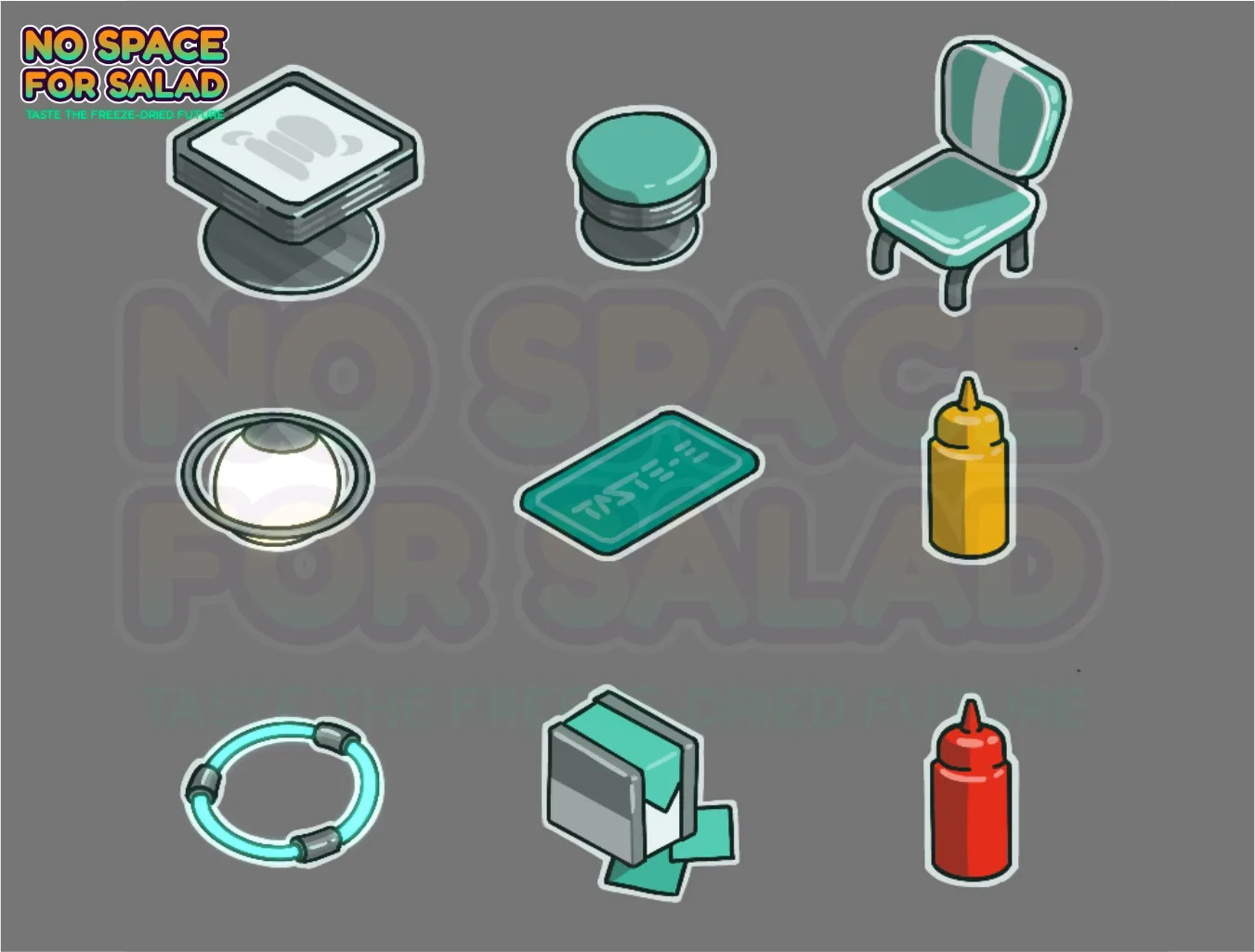
What would a restaurant game be without the ability to add tables? That’s now a thing.
This mechanic always felt like an obvious feature, and we finally finished designing it in this prototype version. It’s still in its early stages - for now, you can only place tables and chairs - but it opens up some very interesting possibilities for the future.
Oh I forgot! Players can also add tiles to expand the dining area!
From the start, our intention was to avoid breaking the game’s flow - especially the restaurant flow. We really wanted room editing not to be restricted to moments when the restaurant is closed (a shortcut many games take), but instead allow players to move chairs while customers are actually sitting on them.
This added a fair amount of complexity, but it’s a decision we absolutely don’t regret.
Customer AI adapts to these new table layouts without ever punishing the player, and it’s actually pretty funny to mess with customers who were peacefully eating and suddenly have to look for a new seat, plate in hand.
Eventually, players will be able to fully decorate the restaurant, which opens up some great long-term evolution opportunities for this system.
The Shop
Even though it’s still fairly basic, we added a first version of a shop inside the restaurant.
It still allows players to buy frozen ingredients, but also upgrades for the player — both for exploration and cooking.
This is only a first iteration, and it will definitely evolve (we already have other ideas for this shop — maybe a wandering merchant?).
For now, it introduces a first real money sink for the player, helping rebalance the game’s overall flow.
V2 Wrap-Up
Prototype v2 represents a solid step forward in the game’s development and was very well received by our playtesters — who, once again, played for much longer than we initially expected.
Our goal of making exploration more interesting was clearly achieved!
Players actually spent more time exploring than running the restaurant, which means we now have a slight imbalance in favor of exploration this time around.
We can already feel that this will be a constant back-and-forth between the two gameplay phases, making sure they remain equally engaging. Future additions should help give the restaurant more impact again.
We also noticed that the oxygen system (which was heavily reworked) isn’t always well understood. It’s a major lever that needs improvement in the next version.
We seriously debated removing oxygen altogether, but for now it still feels very important to convey a sense of progression and reward players for going farther and farther on each planet.
Overall, we still have a lot of work to do on visual and audio feedback to help players better understand the mechanics — and that’s exactly what prototype v3 is about.
V3 Goals
We’re now entering the first real polish phase of the game.
We’re not adding anything major anymore — we’re focusing on improving what’s already there.
This will help us better evaluate whether the mechanics are clearly understood and improve the overall game feel of the core systems.
This isn’t just about animations and FX, but everything related to UX: UI, information clarity, feedback, sounds, and more.
The goal of v3 (and v4, which will follow very quickly) is to present a first public demo.
Unfortunately, we can’t guarantee that it will be released on Itch (but maybe!). It will be showcased at Corsica Games Week in April, where we’ll get our first real test with a wide and diverse audience.
It’s a relatively small festival, but for non-French readers: it takes place on an island in the south of France, in the region where the game was born — yes, this game comes from there.
You can also find a blog post dedicated to us on the festival’s website (in French, sorry) blog link. If you’re around, don’t hesitate to come say hi!
We hope that by then, we’ll be able to present a version of the game that already feels accessible — and makes you want to wishlist it 😉
The next devlog will most likely focus on this festival experience and include a breakdown of the new version.
If you have any suggestions or ideas to improve the game, feel free to leave a comment!
See you very soon!